

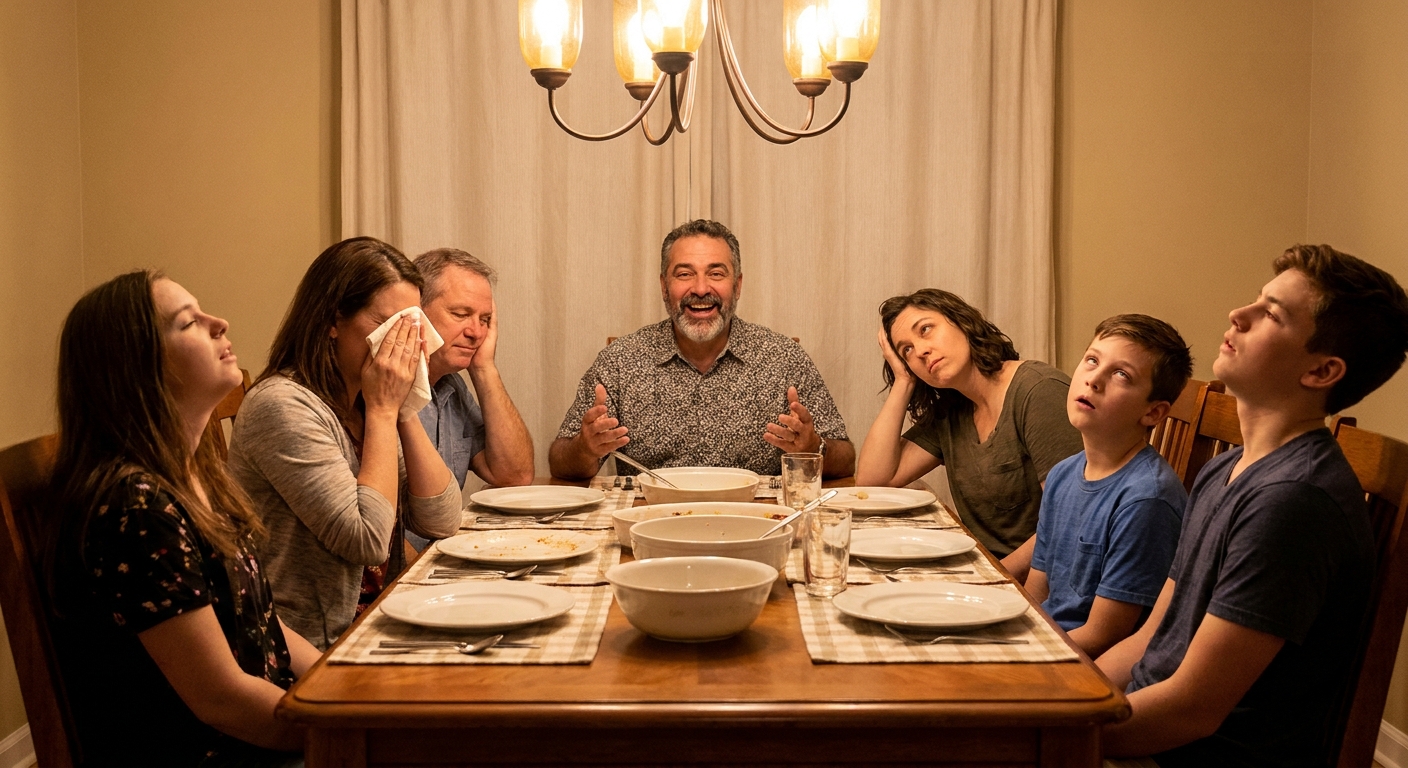
I grew up in a house where “pass the peas” could become a 10-minute linguistic crime spree. Dinner was less “family meal” and more “open mic night for people who think homophones are a personality.” So when someone asks me how to craft a dad joke, I do what any responsible adult would do: I sharpen my pencil, ignore the eraser, and start dissecting the groan.
This is a practical, step-by-step guide to building clean, classic dad jokes and puns, plus the wordplay formulas that make them both terrible and, somehow, excellent.
What makes a dad joke?
A dad joke is not just “a joke told by a dad.” It is a specific kind of humor that wins by losing. A proper groaner has a few signature traits:
- It is predictable in the best way. The punchline feels inevitable once you hear it, like stepping on a rake you already saw.
- It is clean and widely shareable. If you cannot say it at a family reunion without starting a small feud, it is not living its best dad life.
- It relies on language tricks. Puns, double meanings, deliberate misunderstandings, and overly literal interpretations.
- The reaction is part of the joke. The sigh, the groan, the eye roll. That is applause in a different key.
For more of the wholesome, pun-forward corner of the internet, our Funny English guide and Puns and Jokes guide are basically the two drawers in my brain labeled “Do Not Open During Serious Conversations.”
Dad joke checklist
When a dad joke works, it usually follows this little blueprint:
- 1) A normal setup. Something ordinary enough to slip past your audience’s defenses.
- 2) A hidden word trap. A word with two meanings, or one that sounds like another word.
- 3) A hard turn. The moment the joke swerves from “normal conversation” into “sir, this is a pun.”
- 4) A short punchline. Quick, clean, and preferably slightly unnecessary.
- 5) A confidence finish. Do not apologize. Dad jokes do not limp. They strut.
How to write a dad joke
Step 1: Pick a plain topic
The best ingredients are boring on purpose. Think: food, animals, weather, school, tools, chores, office life.
- Food: bread, cheese, peas, jam
- House stuff: vacuum, ladder, batteries
- Animals: cows, fish, cats, ducks
- Weather: rain, thunder, snow
Step 2: Find a word with a double life
You are hunting for:
- Homophones (same sound, different meaning): flour/flower, knight/night
- Multiple meanings: rock (stone or music), draft (beer or a version of writing)
- Easy-to-confuse spellings (works on the page, not out loud): dessert/desert
- Common phrases you can twist: “No pressure,” “I’m on it,” “That rings a bell”
Step 3: Pick a format
Dad jokes love dependable containers. Here are the classics you can reuse forever.
Format A: Question and answer
Why did...? / What do you call...? / How do you...?
- Setup: What do you call a fish wearing a bowtie?
- Punchline: Sofishticated.
Format B: “I’m reading a book on...”
This is the dad joke equivalent of a reliable minivan.
- Setup: I’m reading a book on anti-gravity.
- Punchline: It’s impossible to put down.
Format C: Deliberate misunderstanding
Someone says something normal. You interpret it in the most literal way possible.
- Person A: Can you give me a hand?
- Person B: I would, but I’m rather attached to mine.
Format D: Two-part pun
- Setup: I used to be addicted to soap.
- Punchline: But I’m clean now.
Step 4: Keep it tight
Dad jokes do not explain themselves. They arrive, drop the pun, and stand there smiling like they just fixed the sink.
If you feel the urge to add a second sentence, trim instead. The groan lives in the snap.
Step 5: Test it out loud
Say it like you mean it. Dad jokes are performance, not just text.
- Pause before the punchline.
- Smile like you are proud of your terrible choices.
- Hold eye contact for one beat too long.
Pun engines
These are the wordplay engines underneath a lot of classic groaners. Once you see them, you can generate your own like a small pun-powered factory.
1) Homophone swap
Formula: Replace a key word with a same-sounding word.
- I tried to catch fog yesterday. I mist.
- Did you hear about the guy who invented Lifesavers? He made a mint.
2) Double meaning
Formula: Use a word that naturally carries two meanings.
- I used to be a baker, but I couldn’t make enough dough.
- I’m great at archery. I always hit the point.
3) Phrase twist
Formula: Take a familiar phrase and interpret it too literally.
- They told me to watch my step, so I stared at my shoes for ten minutes.
- My friend said he needed space, so I handed him an astronomy book.
4) Sound-alike split
Formula: Take a normal word and “hear” it as two words that fit the situation.
- What do you call a sleeping bull? A bull-dozer.
- Why did the scarecrow get promoted? He was outstanding in his field.
5) Name that thing
Formula: Describe something, then answer with a punny label.
- What do you call cheese that isn’t yours? Nacho cheese.
- What do you call an alligator in a vest? An investigator.
Make it shareable
I love a silly pun as much as the next person with a permanent crossword callus, but the best dad jokes travel well. Here’s how to keep yours broadly lovable:
- Aim up, not down. If the “target” is a person or group, the joke stops being warm and starts being awkward.
- Prefer universal topics. Food, animals, school, weather, household objects. Nobody has to feel singled out by a spatula pun.
- Keep it one-breath short. The longer the setup, the more time your audience has to escape.
- Choose clarity over cleverness. If people need a map, a glossary, and a snack break, it is no longer a dad joke. It is homework.
Language can be messy in fun ways, though. If you enjoy how tiny changes cause big reactions, you will appreciate one comma’s ability to create total chaos.
Use it in real life
A dad joke changes slightly depending on where you drop it. Same pun, different blast radius.
- With kids: Use concrete topics (animals, food, school) and make the pun word loud and obvious.
- At work: Keep it quick and neutral. Office objects are your friends: pens, calendars, meetings, coffee.
- In a classroom: Use it to reinforce a word (homophones, double meanings). The lesson sneaks in wearing a fake mustache.
- With strangers: Choose the cleanest, simplest version. You want a polite groan, not a concerned silence.
Word prompts
If your brain is idling in neutral, steal a starter list. These words come preloaded with double lives:
- Food: jam, toast, dates, batter, pepper
- Tools and house stuff: drill, level, saw, ladder, sink
- School and office: notes, paper, ruler, staple, schedule
- Weather: hail, forecast, breeze, current, cloud
Quick workshop
Let’s assemble a fresh groaner together.
Example: batteries
- Topic: Batteries
- Double-life word: “charged” (electrical and accused)
- Format: Two-part pun
Result: I got arrested at the battery store. Apparently I was charged.
Example: jam
- Topic: Jam
- Double-life word: “stuck” (traffic jam and physically stuck)
- Format: Two-part pun
Result: I was going to tell a joke about a traffic jam, but it got a little stuck.

Common mistakes
- Mistake: The punchline is too far from the setup.
Fix: Make sure the pun word is clearly connected to the topic. - Mistake: Too many moving parts.
Fix: Strip it down to one twist. Dad jokes are minimalist comedians. - Mistake: You explained the pun.
Fix: Never explain. If they ask, just grin like a person who absolutely will do it again. - Mistake: The joke relies on spelling that does not work out loud.
Fix: Test it spoken. Dad jokes are oral tradition, like lullabies or arguing about thermostats.
If you like the idea of humor hiding inside contradictions, you might also enjoy our collection of funny oxymorons we say with a straight face.
Groan Meter
Before you unleash your creation on innocents, run it through this checklist:
- Is it clean? Safe for kids, coworkers, and grandparents.
- Can I say it in one breath? If not, shorten.
- Does it hinge on one clear word trick? Good.
- Would a reasonable person sigh? Perfect.
- Am I slightly proud of how bad it is? Required.
FAQ
Are dad jokes always puns?
Most are pun-adjacent, but not all. Some are just gloriously literal misunderstandings or overly tidy one-liners. Puns are the power tool, not the entire toolbox.
How do I get better at making puns?
Collect “double-life” words (charged, right, sole, plane, current, date) and practice plugging them into the formats above. Also, listen for phrases people say automatically. Dad jokes love autopilot language.
What if nobody laughs?
Then you are doing it correctly. A dad joke is successful when the room makes a sound like a door slowly closing.
Where can I find more clean humor on Innocent English?
Start with Puns and Jokes and Funny English. That should keep your household groaning for quite some time.
Parting advice
Crafting the perfect dad joke is like fixing something around the house. You do not need fancy equipment. You need confidence, a little patience, and a willingness to accept that someone will say, “Please stop.”
Now go forth and pun responsibly. Or irresponsibly, but politely.