

I grew up in a house where passing the salt came with a side of wordplay. My family could turn a dinner table into a pun arena faster than you could say “peas and thank you.” So when I first met a rebus puzzle, it felt like language had put on a little costume. Same jokes, same groans, but now with pictures, spacing, and sneaky layout tricks.
A rebus puzzle is visual wordplay: you read images, letters, numbers, and their positions as clues to a word, phrase, idiom, or famous saying. Think of it as a pun that went to art class.
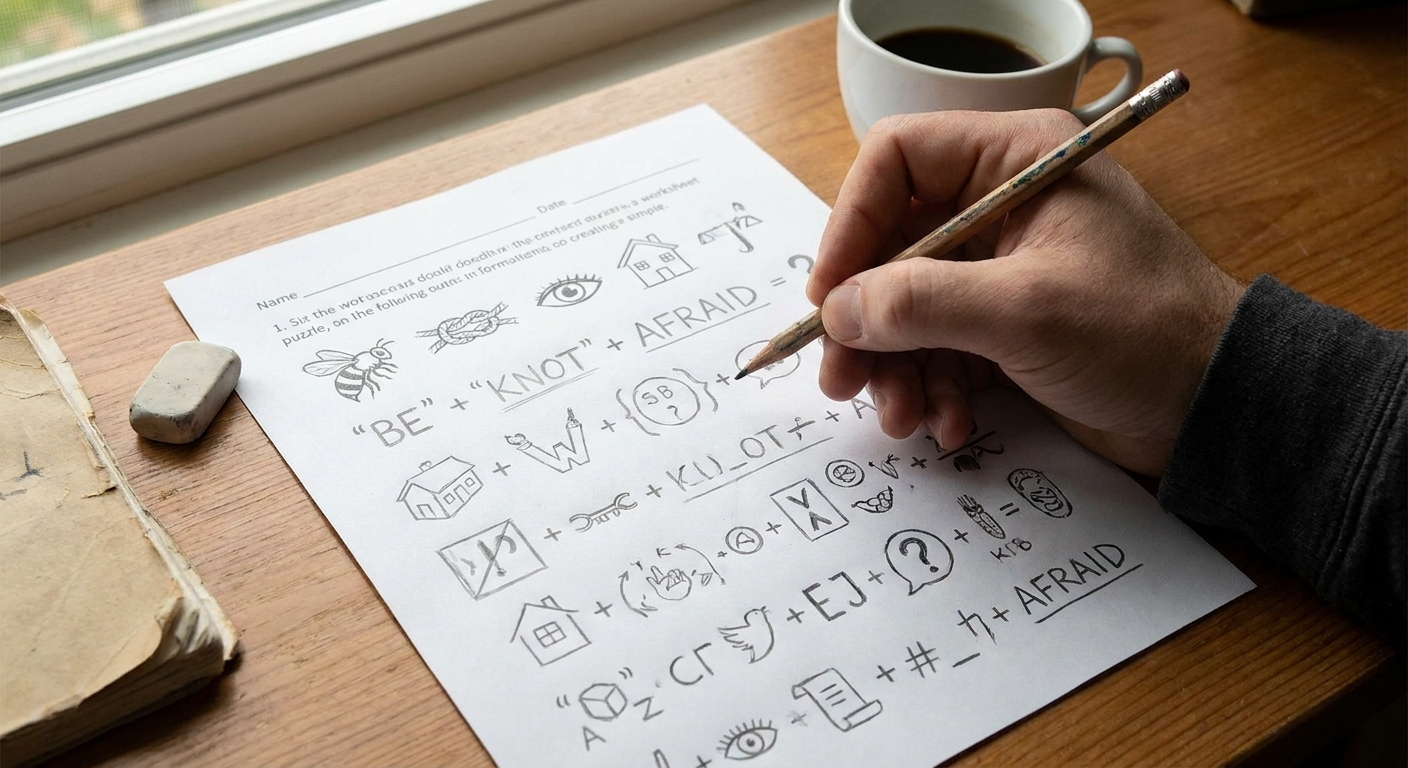
What a rebus is (and why your brain loves it)
Rebuses work because English is gloriously flexible. A picture can stand for a sound, a whole word, or even an idea. And layout can act like a verb. A word under another word can literally mean “under.” A word repeated can mean “again,” “many,” or “too much.”
Most rebuses use a few core tricks:
- Sound-alikes: a picture of an eye = “I.”
- Symbols and numbers: 4 = “for,” 2 = “to/too,” + = “and.”
- Positioning: over, under, inside, backwards, crossed out.
- Repetition and spacing: “too many,” “far apart,” “split,” “crowded.”
If you enjoy other clean forms of word-twisting, you might also like our guide to clean double entendres, which is basically verbal mischief with good manners.
How to solve a rebus step by step
When people get stuck on rebuses, it is usually because they are reading them like normal sentences. A rebus is more like charades mixed with a crossword clue. Here is the method I use at trivia nights.
1) Name everything you see
Don’t interpret yet. Just list it.
- Objects: cat, bee, key, apple
- Letters: A, B, C
- Numbers: 2, 4, 8
- Symbols: +, =, arrows
2) Say each item out loud
Rebuses are shameless about sounds. “Eye” becomes “I,” “bee” becomes “be,” “pair” becomes “pear,” and so on. If the puzzle includes a picture you cannot name cleanly, try a simpler synonym. “Couch” might need to become “sofa.”
3) Check for position words
Look at how items are arranged. Layout is grammar in a rebus.
- On top of can mean “over,” “above,” “on.”
- Inside can mean “in,” “within,” “surrounded by.”
- Crossed out can mean “no,” “not,” “without.”
- Upside down can mean “turned,” “upended,” “topsy-turvy.”
- Backward can mean “back,” “return,” “reverse.”
4) Count repeats and notice spacing
Three of something is rarely just three of something.
- A word repeated might mean “again,” “always,“ “too much,” or “many.”
- Items far apart might mean “far,” “distance,” “apart,” “long way.”
- Items crammed together might mean “tight,” “close,” “packed.”
5) Guess the category
Most rebuses resolve into one of these:
- Common idiom (best bet): “back to square one,” “mind over matter.”
- Everyday phrase: “time is money,” “call it a day,” “no problem.”
- Movie or book title: often uses literal images.
If you want more idioms to feed your rebus-making habit, browse these bizarre English idioms. They practically beg to be turned into pictures.
6) Test your answer like a sentence
Once you have a candidate phrase, see if every part of the rebus can be explained by a piece of it. Good rebuses feel satisfying because the logic snaps into place.
A quick solve walkthrough
Here is a simple one, solved using the steps above.
- Puzzle: the word MIND printed above the word MATTER
- Step 1 (name it): the word MIND, the word MATTER, and MIND is positioned above MATTER.
- Step 2 (say it): mind, matter.
- Step 3 (position): above often means “over.”
- Step 5 (category): sounds like an idiom.
- Answer: Mind over matter
If you can explain each element without squinting or arguing about fonts, it is probably a fair rebus.
The rebus toolbox
Here are the reliable mechanics that show up again and again. Once you learn these, rebuses start feeling less like magic and more like a friendly code.
| Visual clue | Often means | Example idea |
|---|---|---|
| Word written smaller | little, minor, small | tiny “PROBLEM” = “small problem” |
| Word written larger | big, major, grand | huge “NEWS” = “big news” |
| Word inside another word/shape | in, within, inside | “HE” inside “ART” = “heart” |
| Word above another | over, on, above | “MIND” over “MATTER” = “mind over matter” |
| Word below another | under, beneath | “WATER” under “BRIDGE” = “water under the bridge” |
| Word repeated many times | too much, lots, many | “WORK” written five times = “too much work” |
| Word split in two | broken, divided, split | “DECISION” with a big gap = “split decision” |
| Word backwards | back, reverse, return | “FLOW” written as “WOLF” = “backflow” |
| Crossed-out item | no, not, without | “FEAR” crossed out = “no fear” (or “fearless,” as in “without fear”) |
Notice how often rebuses rely on very plain direction words (over, under, back, in). Those are your best friends.
How to create your own rebus
Creating a rebus is like hosting guests. You want them challenged, not stranded on the porch in the rain.
Step 1: Pick a phrase with a clear hook
Idioms and common sayings are perfect because the solver gets that “aha” payoff. Choose something most people recognize. If you are making a rebus for kids or a mixed-age group, avoid obscure sayings and slang.
Step 2: Break it into parts
Write your target phrase and split it into 2 to 5 chunks.
- “Break the ice” becomes: break + the + ice
- “Spill the beans” becomes: spill + beans
- “Piece of cake” becomes: piece + cake
Then decide which chunks should be pictures and which should be layout tricks.
Step 3: Choose your rebus style
Most creator confusion comes from mixing styles. Decide early:
- Sound-based rebus: pictures stand for sounds (bee = “be”).
- Literal rebus: pictures stand for words (cake = “cake”).
- Spatial rebus: arrangement does the heavy lifting (word over word).
You can mix them, but do it on purpose and keep the mix small.
Step 4: Use positioning like verbs
This is where visual puns really shine. Instead of drawing “over,” you can place one thing over another. Instead of writing “inside,” you can put a word inside a box or another word.
Step 5: Build in fairness
Here is my “no tantrums at the kitchen table” checklist:
- Avoid ultra-specific pictures (a “beagle” is just a “dog” to most people).
- Prefer simple nouns (cat, book, key, sun).
- Give at least two routes when possible (picture plus placement, or picture plus repetition).
- Test-solve it yourself the next day. If you cannot solve your own puzzle, you have made modern art, not a rebus.
Step 6: Add a gentle hint for games
At trivia, I will sometimes label the category verbally, not on the puzzle itself. For example: “This one is a common idiom.” That tiny nudge makes the puzzle feel clever instead of cruel.
Examples you can try (with answers)
These are written as plain text descriptions so you can picture them easily. If you are drawing them, keep it simple.
1) Mind over matter
- Puzzle: the word MIND printed above the word MATTER
- Answer: Mind over matter
2) Split decision
- Puzzle: the word DECISION written with a big gap in the middle (DECIS ION)
- Answer: Split decision
3) Back to square one
- Puzzle: a simple square shape with the number 1 inside it, plus a curved arrow pointing back toward it
- Answer: Back to square one
4) Too cool
- Puzzle: the word COOL written twice (COOL COOL) or the word COOL with a small “2” next to it
- Answer: Too cool
If you like wordplay that also leans on how it looks, palindromes scratch a similar itch. Our collection of mind-bending palindromes is a fun companion read.
Rebus ideas
If you want a starter list of phrases that practically draw themselves, try these:
- Hit the nail on the head
- Under the weather
- Raining cats and dogs
- On thin ice
- The last straw
- Hold your horses
- Let the cat out of the bag
- Time flies
- Bite your tongue
- Cut corners
Many of these overlap beautifully with pun-friendly themes, like food and animals. If you are in that mood, wander over to food puns or animal puns and you will find plenty of picture-ready nouns.
Common mistakes
Making the picture too specific
Problem: You drew a ukulele, expecting “music.” Fix: Use a music note, headphones, or the word “MUSIC.” Keep the clue universal.
Relying on one fragile pun
Problem: The whole puzzle hinges on whether someone calls it a “sofa” or a “couch.” Fix: Add a second cue, like positioning, repetition, or a partial word.
Using tiny layout differences
Problem: “Over” is shown by a barely higher placement. Fix: Make the spatial relationship obvious. Rebus solving is not an eye exam.
Accidentally creating multiple valid answers
Problem: Your puzzle could be “under pressure” or “low stress,” and both fit. Fix: Add one extra element that clearly chooses the intended phrase.
Quick rebus FAQ
Are rebus puzzles the same as dingbats?
They are close cousins. Dingbats is a popular rebus-style format where the typography and layout do most of the work. In casual conversation, people sometimes use the terms interchangeably, but in puzzle circles “dingbats” is often treated as a specific style under the wider rebus umbrella.
Do rebuses have to include pictures?
No. Some are made entirely from words arranged in clever ways. Pictures just make them feel extra playful.
What is the best difficulty level for a party?
Easy to medium. A good party rebus is solvable in under a minute once someone gets the idea. If you want harder ones, mix in a theme (like “movie titles”) so solvers at least know what shelf to search.
Can I make rebuses kid-friendly?
Absolutely. Stick to familiar objects, keep the puns clean, and choose phrases kids have actually heard. If Grandma can solve it and a teenager will roll their eyes, you have hit the sweet spot.
One last tip
If you want to get good fast, do two things: solve a few rebuses every day, and start inventing your own using everyday idioms. The real secret is noticing how often language is already visual. “Over,” “under,” “inside,” “back,” “broken,” “split.” Those are not just words. They are little stage directions, and rebuses let you act them out.
And if your first attempt earns a groan, congratulations. You are officially speaking my family’s love language.
For more clean wordplay rabbit holes, you can browse the Puns and Jokes guide, or learn more about me over on my author page.