

There are few sounds in the English-speaking world that are as instantly recognizable as a tiny rhythm on an imaginary door followed by two little words: “Knock knock.” It is the comedic equivalent of a doorbell. Most people in the room perk up, not because danger is coming, but because something is about to happen and the format has promised it.
I grew up in a house where the dinner table was essentially an open mic night for puns. Knock-knock jokes were the easiest way for a kid to get the floor. You did not need to be witty on your feet, you just needed the courage to start the ritual. And the ritual is the secret. The classic formula works because it is not just a joke. It is a tiny, structured social game with a built-in runway for laughter.
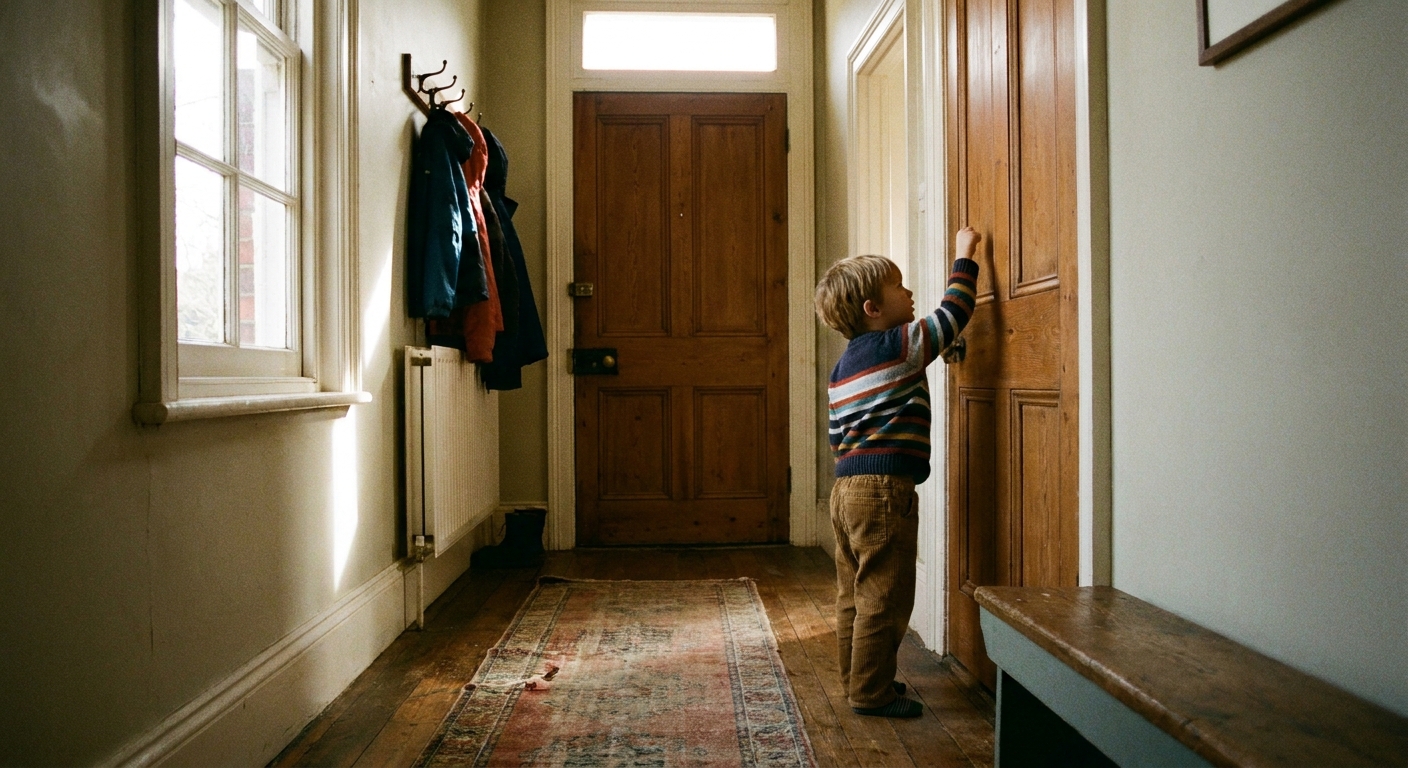
The formula is a contract
A knock-knock joke looks simple on the page, but in real life it behaves like a handshake. Two people agree, in public, to cooperate for a moment. That cooperation is the first ingredient.
Here is the “contract” in its most basic form:
- Initiation: “Knock knock.”
- Acceptance: “Who’s there?”
- Setup name or phrase: “Banana.”
- Prompt for clarification: “Banana who?”
- Payoff: The punchline.
Notice how the listener does half the work. They must say “Who’s there?” and then they must ask “X who?” Those lines are not filler. They are participation. Psychologically, participation buys attention and goodwill. Linguistically, it gives the teller permission to delay the punchline and build a tiny bit of suspense.
This is one reason the format is so durable. Even when the punchline is groan-worthy, everyone has already invested in the exchange. The laughter is partly about the wordplay, and partly about the shared act of getting to the end together.
Why the opening works
Those two words do a surprising amount of work.
1) It creates a scene
Even if nobody is near a door, the listener instantly imagines one. There is an implied setting, an implied visitor, and an implied mystery. That quick little mental stage is perfect for comedy because it gives the brain something concrete to hold while the joke takes a turn.
2) It signals safe humor
“Knock knock” has a childlike innocence baked in. It sets expectations: we are not doing harsh sarcasm, roasting, or anything too spicy. We are doing a clean little trick with words. That makes people more willing to play along, especially across generations.
3) It forces turn-taking
Conversation is messy. People interrupt, talk over each other, drift off. Knock-knock jokes are the opposite. They are tightly turn-based. That structure reduces social uncertainty, which makes the timing easier to control and the payoff easier to land.
The hidden engine
Most knock-knock jokes are powered by one of three linguistic sleights of hand:
- Homophones: words that sound alike, like “Lettuce” and “let us.”
- Near-homophones: close-enough sound matches, like “Europe” and “you’re up,” in many accents.
- Rebracketing: when the ear rearranges word boundaries, like hearing “a notion” inside “an ocean.”
The format helps these tricks because it splits the setup into two steps. You hear the name first. Then you hear it again in “X who?” That second pass encourages your brain to search for meaning, and your brain is a meaning-making machine. It cannot help itself.
In other words, the listener is not just waiting. They are actively predicting. Comedy loves prediction because laughter is often what happens when the prediction is nudged sideways at the last second.
Timing matters
If you have ever heard a knock-knock joke fall flat, it was probably not the wordplay’s fault. It was the pacing. The format is essentially a set of speed bumps designed to control rhythm.
“X who?” is a drumroll
That line buys you a tiny pause before the punchline, which is where anticipation grows. Deliver the punchline too fast and the audience has not formed an expectation. Deliver it too slowly and the expectation deflates. Knock-knock jokes teach timing the way training wheels teach balance.
Use small performance cues
- A slight pause after “Who’s there?”
- A confident, clean delivery of the “name” word
- A beat after “X who?” so the room leans in
This is also why the jokes work so well in groups. When multiple people say “Who’s there?” together, the timing becomes communal. Everyone is literally on the same beat.
Why repetition lands
Some knock-knock jokes are not really about cleverness. They are about stubborn persistence, like the classic banana routine:
Knock knock.
Who’s there?
Banana.
Banana who?
Knock knock.
Repeat until the listener begs for mercy, then switch to “Orange” and “Orange you glad I didn’t say banana?”
This works because repetition builds tension and a mild sense of impatience, then releases it with a final twist. The punchline is not only the pun. The punchline is the relief of change.
It is also an early lesson in comedic rule-making: once you establish a pattern, the audience starts to believe the pattern is the law of the universe. Breaking it is funny.
The listener helps write it
Knock-knock jokes are unusually democratic. The listener supplies the questions that make the punchline possible. That makes the listener feel clever when the punchline arrives, even though the teller did the planning.
This is why the jokes are so effective with kids. They are not passive consumers. They are partners. They learn timing, pronunciation, and the idea that words can have hidden doors inside them.
If you enjoy this kind of audience participation, you might also like our breakdown of classic groaners in The Anatomy of a Dad Joke.
The door is a permission slip
There is a social advantage to the door premise: it lets the teller be silly without needing a big excuse. In normal conversation, blurting out a pun can feel like interrupting traffic. The knock-knock format creates a designated crosswalk. Everyone knows what is coming through.
It is also gently mischievous. A visitor at the door is unexpected. Unexpected equals attention. Attention equals comedy runway. The joke’s setting is doing crowd control for you.
What makes one good
I judge knock-knock jokes the same way I judge crossword clues: by fairness. A good one is solvable. The sound-alike should be close enough that the listener thinks, “Oh, I should have caught that.”
Quick checklist
- Clear pronunciation: If the “name” needs five explanations, it is not a knock-knock joke anymore. It is a hostage negotiation.
- One main trick: The best ones have a single pivot point. Too many pivots and the room gets lost.
- Age-appropriate images: Think animals, food, weather, everyday objects. Those land across generations.
- A punchline you can say proudly: Innocent English rule: no regret after the laugh.
Need a refresher on what counts as “clean” but still clever? Our piece on clean double entendres is a good companion, especially if you like jokes that behave themselves in polite company.
Common pitfalls
If you want a knock-knock joke to land in the real world, here are the usual ways it goes sideways:
- The setup is a mouthful: If the “name” needs a running start, shorten it until it can be said in one clean breath.
- The pun depends on one accent: If you have to announce, “Okay, say it like this,” the moment gets wobbly. Either tweak the sound-alike or pick a different target phrase.
- You do not leave space for the response: The listener’s lines are part of the rhythm. Pause and let them earn their “Who’s there?” like they trained for it.
- Too much room noise: These jokes live and die by syllables. If the kitchen blender is auditioning for a rock band, wait ten seconds.
More examples
Two classics can carry an explanation, but a few extra examples help show how flexible the format really is. Here are a handful that stay clean and rely on the same core mechanics.
Knock knock.
Who’s there?
Owls.
Owls who?
Yes, they do.
Knock knock.
Who’s there?
Icy.
Icy who?
Icy you over there, looking suspiciously warm.
Knock knock.
Who’s there?
Tank.
Tank who?
You’re welcome.
How to write your own
Here is my favorite simple method. It is less “sit down with a quill” and more “raid the pantry for word sounds.”
Step 1: Pick a target phrase
Examples: “let us in,” “I am a little,” “to whom it may concern,” “ice cream.”
Step 2: Find a “name” sound
- “Lettuce” for “let us”
- “Icy” for “ice”
- “Al” for “a” and then you can build from there
Step 3: Write the payoff
Knock knock.
Who’s there?
Lettuce.
Lettuce who?
Lettuce in, it’s cold out here.
That is the classic shape: name-word that seems like a person, then reveal it as part of a normal sentence.
Step 4: Say it out loud
Knock-knock jokes live in the mouth, not on the page. If you cannot say it smoothly, simplify it until you can.
If you want to branch into other structured joke formats, you might enjoy Tom Swifties. They scratch the same itch: a predictable setup that makes the punchline feel inevitable.
Why it still works in 2026
Knock-knock jokes have survived plenty of cultural shifts because they are built on human basics that do not go out of style:
- Pattern recognition: Our brains love predicting what comes next.
- Play: The format turns language into a toy you can share.
- Belonging: Call-and-response creates instant togetherness.
- Low stakes: You can bomb safely. The door absorbs the embarrassment.
Also, and I say this as someone who does crosswords in pen like a man daring fate, the format is comfortingly stubborn. The world changes, slang mutates, and yet “Who’s there?” remains the same little invitation it has always been.
FAQ
Are knock-knock jokes always puns?
Most are, but not all. Some are anti-jokes, some are repetition gags, and some are pure nonsense. The common thread is not the pun. It is the structure and the cooperative rhythm.
Why do kids love knock-knock jokes?
Because they get to control the room with a predictable script. It is a safe way to practice timing and word sounds, and it reliably earns attention from adults.
Why do adults groan, but still play along?
Because the groan is part of the social ritual. In the same way a dad joke often earns a theatrical eye-roll, the knock-knock joke earns a ceremonial “Oh no.” It is affection disguised as suffering.