

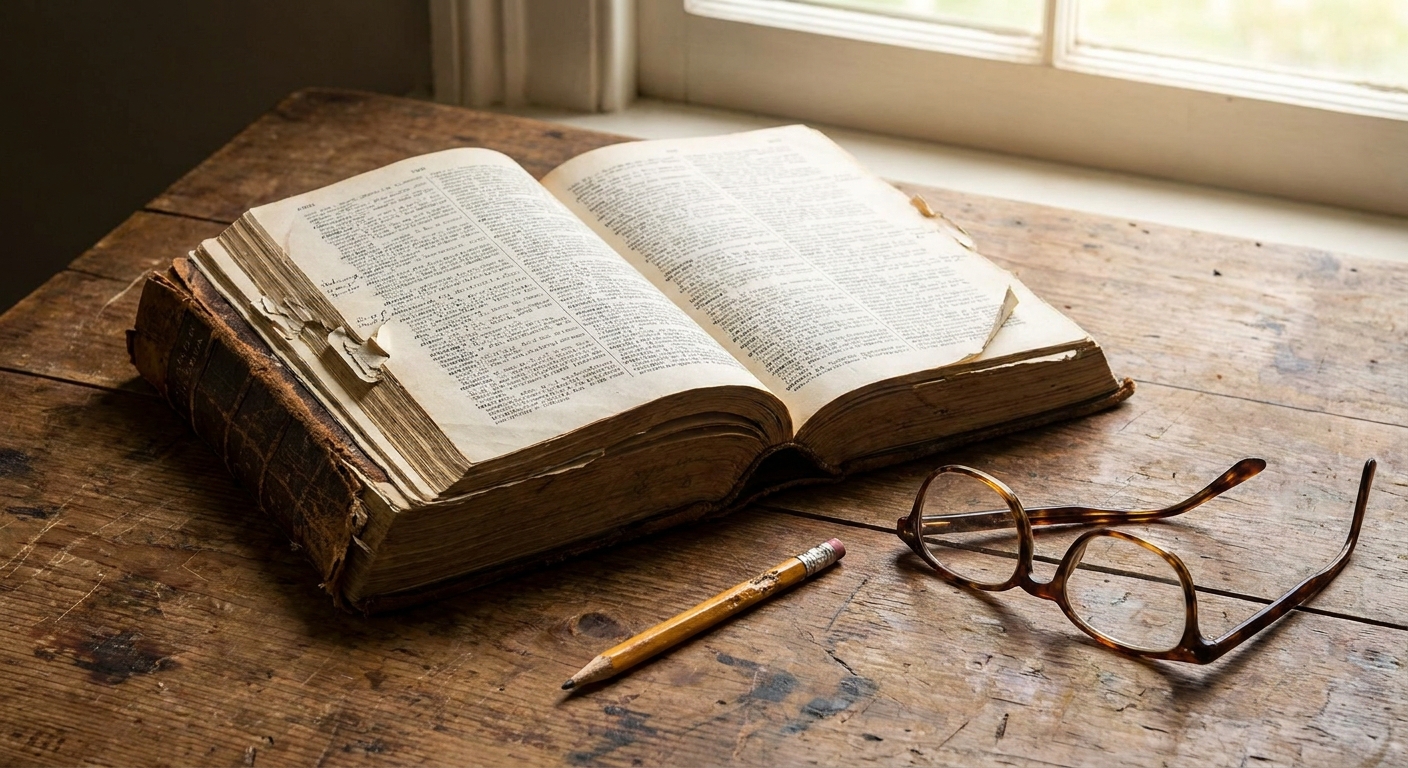
I grew up in a household where the dinner table had two sacred rules: pass the potatoes, and never let a perfectly good pun go unserved. Somewhere between “Dad, please stop” and “Okay, that one was kind of funny,” I developed a fascination with how words get invented, misheard, borrowed, and occasionally elbowed into polite company.
Which brings us to one of my favorite language mysteries: how does a word that starts as nonsense, slang, a typo, or a movie quote end up looking official and well-behaved in a dictionary?
The short version is this: dictionaries do not decide what English should be. They record what English is doing out in the wild, whether we are proud of it or not.
Dictionaries do not “add words”
You will often hear dictionaries say they “add” new words, especially in public updates and press releases. That is fair as shorthand. Behind the scenes, what they are really doing is documenting evidence that a word is being used in durable, trackable ways.
Lexicography sounds like the sort of job where you get to sit in a tweed jacket and judge people for saying “irregardless.” In reality, modern dictionaries are closer to very serious scrapbooks.
Editors gather citations, meaning real examples of a word being used by real people in real sources. Historically that meant books, newspapers, magazines, transcripts, and letters. Today it also includes broadcast media, and other published material that is verifiable and datable.
Once a candidate word has enough evidence, editors ask practical questions:
- Is it used by more than one person? A single comedian’s pet catchphrase might not make it.
- Is it used by more than one source? Dictionaries love independent sightings.
- Does it have a stable meaning? If a word means five different things depending on the day, it needs time to settle.
- Is it sticking around? Some words are fireflies: bright for a summer, gone by fall.
- Can we define it clearly? If the definition collapses into a circular “it means… itself,” you have a problem.
This is why dictionary updates can feel “late.” They are not late. They are cautious. English changes quickly. Dictionaries tend to wait until the change looks less like a fluke and more like a pattern.
How “fake” words become real
1) Slang proves it has legs
Slang is the classic route. A word begins as an in-joke in a community, then spreads. Once it shows up consistently across time and sources, it starts looking less like a fad and more like vocabulary.
If you enjoy tracking the clean side of modern slang (and occasionally translating it for baffled adults), you might like our guide: A Parent’s Guide to Clean Internet Slang.
2) Pop culture coinages escape the show
TV, movies, music, and games are word factories. Some terms stay locked to a single title. Others break out and start working regular jobs in everyday conversation.
When a catchphrase becomes a general-purpose word, dictionaries take notice. We have a whole tour of the phenomenon here: From D’oh to Bazinga: TV Catchphrases We All Speak Now.
3) A mistake becomes the new normal
My favorite linguistic plot twist is the “oops-to-official” pipeline. A misspelling, mishearing, or muddled phrase can spread so widely that it becomes its own established form.
Sometimes the new form sits alongside the original. Sometimes it wins outright. If you love these, you will have a grand time with:
4) A new thing needs a name
Some words are not born from silliness at all. They appear because the world changes. New technology, new social habits, and new cultural ideas show up, and language rushes to keep up. Sometimes we borrow an older word and stretch it. Sometimes we build something new from spare parts.
5) Wordplay becomes a workhorse
English loves mashing words together. Portmanteaus and playful blends often start as jokes, then become shockingly useful. Once they are useful, they are hard to un-invent.
If you want a parade of these delightful Frankenwords, visit: Hangry, Spork, and Beyond.
What counts as enough proof?

Different dictionaries have different thresholds, but the general recipe looks like this:
- Multiple citations over time, not just a single viral spike.
- Multiple types of sources, ideally independent publications.
- Clear meaning that can be defined without hand-waving.
- Broad enough usage that an average reader might encounter it.
This is also where dictionaries can differ in personality. A historical dictionary is built to track earliest known uses and how meanings evolve. A general desk dictionary is often more focused on present-day reading needs. Learner’s dictionaries, meanwhile, may be choosier about what helps someone communicate clearly.
Funny real words and why they stuck
Let’s talk about the kind of words that sound fake even when they are printed in a serious font. These are the entries that make you look over your shoulder as if the dictionary might be pranking you.
“Bromance”
Why it feels fake: It sounds like a rejected perfume name.
Why it became real: It neatly labels a specific kind of close friendship and got used widely in entertainment and everyday speech. A useful label is dictionary catnip.
“Staycation”
Why it feels fake: It has that “marketing meeting” flavor.
Why it became real: It filled a real gap. People needed a word for vacation time spent close to home, and the blend is easy to understand at first glance.
“Mansplain”
Why it feels fake: It is obviously constructed.
Why it became real: It names a social behavior people recognized and discussed frequently. Whether you love the term, hate the term, or just want everyone to stop doing the behavior the term points to, it has had sustained, well-documented usage.
“Hangry”
Why it feels fake: It is a joke that accidentally describes a real human condition.
Why it became real: It is short, funny, and genuinely useful. Also, it has probably prevented at least three arguments at my house.
“Emoji”
Why it feels fake: It looks like it should be a brand name.
Why it became real: A new communication tool needed a standard label. Plus, it is a borrowing from Japanese, and English borrows words the way I borrow pens: constantly and without shame.
Notice the pattern: the funniest additions are often not random. They are efficient. They pack a whole situation into one bite-sized word.
Joke words and fictional words
Now we are in my favorite aisle of the language supermarket, the one with the goofy cereal mascots. Words from fiction and comedy can absolutely become “real,” but they have to leave the story and do work in ordinary speech.
A few common pathways:
- A fictional swear word becomes a family-friendly substitute people actually use. We chat about that phenomenon here: Fictional Swear Words in Sci-Fi.
- A catchphrase becomes a general expression, not just a quote.
- A made-up creature or concept becomes a cultural reference that readers expect dictionaries to define.
What usually does not make it: a one-off pun that only works in a single joke, or a novelty spelling that does not stabilize.
How dictionaries handle “wrong” words
Here is the part that makes some people clutch their pearls and others clutch their popcorn: dictionaries sometimes include words that began as mistakes.
That does not mean a dictionary is giving you a gold star for spelling. It means the dictionary is admitting reality: a form exists, people use it, and readers may encounter it and need to understand it. “Irregardless” is the classic dinner-table example, which is why I mentioned it earlier. It tends to show up with a usage note that tells you exactly how editors feel about it.
Good dictionaries try to be clear about status and context. You will often see labels like:
- nonstandard
- informal
- slang
- often disparaging or other usage notes where appropriate
In other words: “This is a thing people say” is not the same as “This is the version you should use in a job interview.”
Modern lexicography tools

Old-school lexicography involved slips of paper and sharp eyes. Modern lexicography still involves sharp eyes, but now those eyes are assisted by searchable databases and large text collections that help editors track:
- earliest known uses
- how a meaning changes over time
- which spellings compete before one wins
- whether a term is confined to one corner of the world or spreading
It is less “word police” and more “word wildlife biologist.” Lots of observing, tagging, and writing down what the creatures are doing when they think no one is watching.
Signs a word is catching on
If you like predicting which “fake” words are going to become frustratingly real, here are a few clues I watch for:
- It shows up without quotation marks. Quotation marks are training wheels, like when writers first try out a new term as “a staycation.”
- People use it earnestly. A word that starts as a joke can graduate to sincere usage.
- It appears in headlines and book titles. Editors love stable, public usage.
- It grows a family. Plurals, verbs, adjectives, and playful variants are a sign the word is settling in.
- It stops needing explanation. The moment a word is used as if everyone already knows it, it is gaining traction.
And if the word inspires groans? Congratulations. It is emotionally resonant, which is half the battle.
FAQ
Do dictionaries add slang now because of social media?
They add slang because people use slang. Social media does make new words spread faster, but dictionaries still look for evidence that usage is real, sustained, and definable.
Which dictionary is the official one?
English does not have a single global authority. Different dictionaries have different audiences and methods. That is why you may see one include a term earlier than another.
If a word is in the dictionary, does that make it correct?
It makes it documented. Correctness depends on context. A dictionary entry often includes labels and notes precisely because context matters.
Why do some silly words feel older than they are?
Because English loves patterns. If a new word is built from familiar pieces, it can sound like it has been sitting around for decades, waiting for us to notice it.
One last word
I like to imagine dictionaries as museums that also run a gift shop. The museum part is careful and historical. The gift shop part is where you pick up a keychain that says “hangry” and somehow feel personally seen.
If you enjoy this kind of language trivia, the quickest way to keep wandering our halls is the main index: Trivia Guide. And if you want to know who keeps leaving puns on the exhibits, that is me: Colin Carmichael.