

In my house growing up, the dinner table had two settings: plates and wordplay. Someone would say, “Pass the rolls,” and another person would reply, “I can’t, they’re on a roll.” Groans followed. That was the applause.
If you want that same warm, low-stakes laughter at your next get-together, a wordplay trivia night is perfect. It works for mixed ages, mixed personalities, and even that one friend who claims they “don’t like trivia” but mysteriously knows antidisestablishmentarianism is commonly cited as having 28 letters.
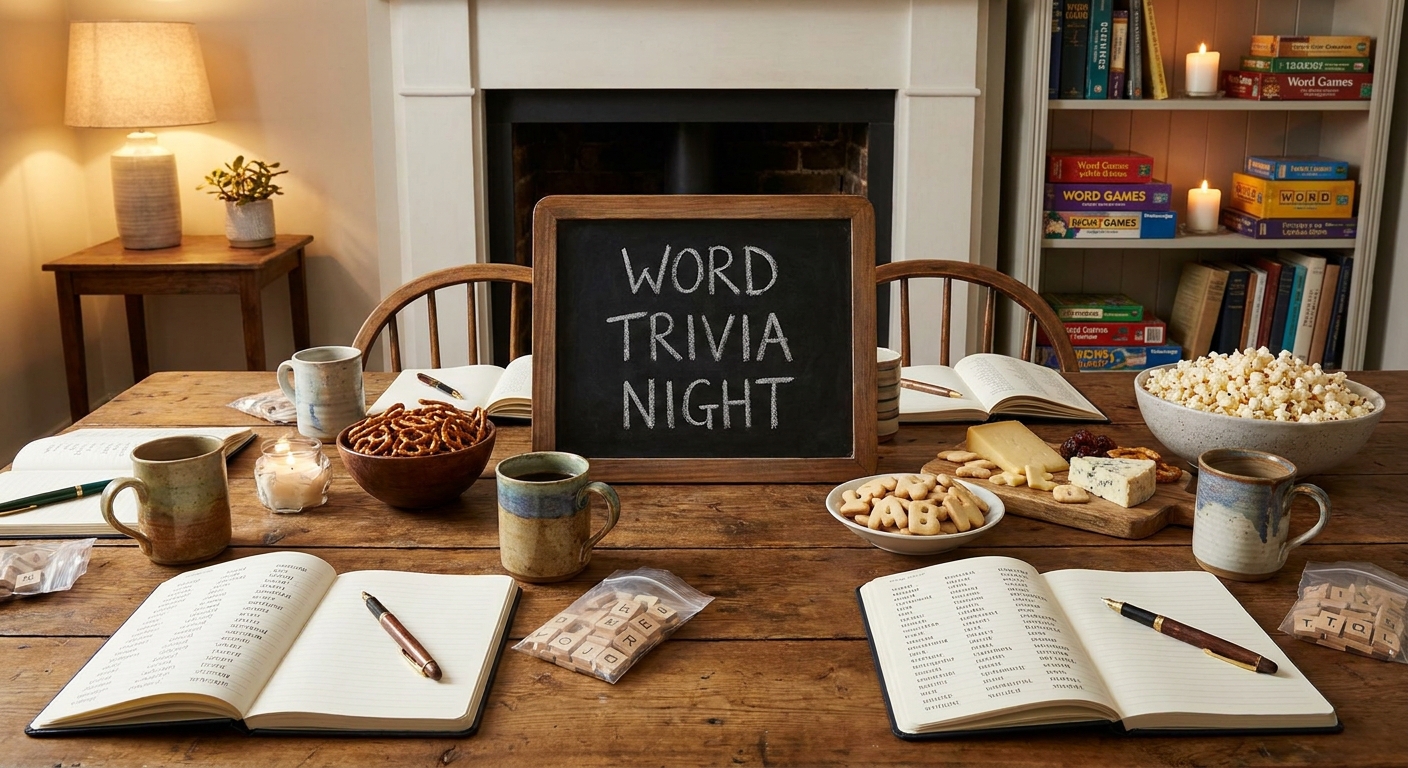
How to host a wordplay trivia night
1) Pick a format that fits your crowd
- Classic trivia: Ask a question, teams write answers, you reveal the correct one.
- Multiple choice: Best for kids, larger groups, or anyone who panics when faced with a blank sheet of paper.
- Steal-style rounds: If a team misses, others can “steal” for half points. Use sparingly unless your family treats competition like an Olympic sport.
2) Keep teams small and balanced
Two to four players per team is the sweet spot. If you have a wide age range, mix it up so every team has at least one confident reader and one person who knows what an idiom is without calling it “a saying thingy.”
3) Use simple scoring
- Most questions: 1 point
- Harder questions: 2 points (I mark these clearly below)
- Tiebreaker: one sudden-death puzzle or “closest answer wins” question
4) Plan the pacing
For a typical party, do 5 rounds of 10 questions. That usually lands you around 45 to 75 minutes once you include reading, arguing that an answer is “basically the same thing,” and the inevitable snack-related negotiations.
Timing tip: Give 20 to 30 seconds for most questions, and 45 to 60 seconds for the (2 points) ones. This keeps things snappy without making anyone feel like they are defusing a bomb made of syllables.
5) Make it feel wordy
A few tiny touches go a long way: a bowl of letter tiles on the table, team names inspired by puns, and a host who reads questions with dramatic seriousness, like the fate of the nation depends on knowing what a spoonerism is.
6) Do a quick materials check
- Pens and paper (or mini whiteboards)
- A timer (a phone is fine as long as it is not also being used to “casually verify” answers)
- A scoreboard (poster paper or a whiteboard)
- A host chair or standing spot (optional, but it adds authority)
- A tiny prize (cookies, bragging rights, or both)
- Optional: letter tiles, sticky notes for team names
Accessibility tip: Read every question aloud, keep the scoreboard big and clear, and feel free to offer one hint per team per game. Nobody should lose because the print was small or the room was loud.
House rules you can read out loud
- No phones during questions. If someone needs a calculator, they are at the wrong party.
- Spelling only matters when the question is about spelling.
- “Close enough” counts if it clearly matches the meaning. The goal is laughter, not a courtroom drama.
- When in doubt, the host decides. Bribes may be paid in cookies.
- Keep it clean, keep it kind, keep it moving.
If you want extra wordplay tools for your night, I have a few related favorites you can borrow from: rebus puzzles, spoonerisms, and Tom Swifties.
The questions: 50 clean language trivia prompts (with answers)
How to use this list: Read the question. Teams write their answer. Then reveal the answer in bold. Questions marked (2 points) are a little spicier, vocabulary-wise, but still family-friendly.
Round 1: Puns and wordplay basics
- What do we call a joke that plays on multiple meanings or similar-sounding words? Pun
- What is the term for swapping the first sounds of two words, like “you have hissed my mystery lecture”? Spoonerism
- (2 points) What do you call a phrase that reads the same forward and backward, like “Never odd or even”? Palindrome
- Which punctuation mark is famous for changing meaning when misplaced, especially in lists? Comma
- What do we call words that sound the same but have different meanings, like “knight” and “night”? Homophones
- What is the name for a word formed by blending two words, like “brunch”? Portmanteau
- (2 points) What do you call a word that imitates a sound, like “buzz” or “bang”? Onomatopoeia
- What do you call a silly, groan-worthy joke with an obvious punchline, often delivered by parents? Dad joke
- What do you call rearranging letters to form a new word or phrase, like “listen” to “silent”? Anagram
- (2 points) What do you call a mistaken phrase that sounds logical, like “old-timers’ disease” instead of “Alzheimer’s disease”? Eggcorn
Round 2: Spelling, letters, and the weirdness of English
- Which letter is silent in the word “knight”? K
- Which letter is silent in “island”? S
- How many letters are in the English alphabet? 26
- In standard modern English, what word famously ends in “-mt”? Dreamt
- (2 points) What do we call letters added to the end of a word to change its meaning, like “-ness” or “-ful”? Suffixes
- What do we call letters added to the beginning of a word to change its meaning, like “un-” or “re-”? Prefixes
- True or false: “I before E except after C” works for all English words. False
- What do we call two identical letters in a row, like the “oo” in “book”? Double letters
- (2 points) What do you call a word that has the same spelling as another word but a different meaning (and sometimes a different pronunciation), like “lead” (metal) and “lead” (to guide)? Homograph
- What mark do we use to show possession in “the dog’s leash”? Apostrophe
Round 3: Idioms and sayings
- If someone says you “hit the nail on the head,” what did you do? You got it exactly right
- What does it mean to “spill the beans”? Reveal a secret
- If you “cost an arm and a leg,” were you inexpensive or expensive? Expensive
- What does “break the ice” mean? Start a conversation or ease tension
- If someone is “under the weather,” how are they feeling? Sick
- (2 points) If you “let the cat out of the bag,” what happened? A secret was accidentally revealed
- What does “once in a blue moon” mean? Very rarely
- If you “bite off more than you can chew,” what did you do? Took on too much
- What does “the ball is in your court” mean? It is your turn to act or decide
- (2 points) If someone says “that’s not my cup of tea,” what do they mean? They do not like it
Round 4: Grammar and usage
- In the sentence “She quickly ran,” what part of speech is “quickly”? Adverb
- What part of speech is a word that names a person, place, or thing? Noun
- What do we call a word that replaces a noun, like “he” or “they”? Pronoun
- Which is correct: “their,” “there,” or “they’re” for “_____ going to the store”? They’re
- What do we call words like “and,” “but,” and “or”? Conjunctions
- (2 points) What punctuation mark typically introduces a list, an explanation, or a dramatic reveal? Colon
- In “The happy dog,” what part of speech is “happy”? Adjective
- Which sentence is correct? A) “Me and him went.” B) “He and I went.” B) He and I went.
- What is the name for a group of words that contains a subject and a verb and can stand alone? Independent clause
- (2 points) What do we call a word that connects a noun to the rest of the sentence, like “in,” “on,” or “under”? Preposition
Round 5: Word origins and quirky language facts
- What do we call words borrowed from another language and used in English, like “café”? Loanwords
- What is the term for a word that is newly created or has a new meaning, like “selfie” when it first appeared? Neologism
- (2 points) What do we call a word that looks the same in two languages but means something different, potentially causing confusion? False friend
- Which language gives English many common words related to law and government after 1066? French
- What do we call a word that is the opposite of another word, like “hot” and “cold”? Antonym
- What do we call a word with a similar meaning to another word, like “big” and “large”? Synonym
- (2 points) What is the term for a word that has the same pronunciation as another word but different spelling and meaning? Homophone
- What is the name for a phrase or clause that has a hidden meaning different from the literal one, often used for humor? Double entendre
- What is a commonly cited, jokingly ironic term for “fear of long words”? Hippopotomonstrosesquipedaliophobia
- (2 points) What is the term for a sentence that contains all 26 letters of the alphabet? Pangram
If your group enjoys the weirder corners of the dictionary, these pair nicely with a trivia night: ridiculous word phobias and long funny words with pronunciation help.
Make it feel like an event
Suggested schedule
- 5 minutes: teams, rules, name your team
- Round 1 and 2: 20 questions
- 5 to 10 minute break: snacks and score update
- Round 3 and 4: 20 questions
- Round 5: 10 questions
- Tiebreaker if needed
Clean bonus round ideas
- Fix the malapropism: Read a wrong phrase, teams write the correct one. For inspiration, see malapropism examples.
- Mini anagram sprint: Give one 6 to 8 letter word, 60 seconds to find as many smaller words as possible.
- Rebus lightning: Show one rebus, first team to solve gets a point.
Hosting tips that save your sanity
- Read answers with a short explanation when needed. A one-sentence definition prevents arguments and teaches something without feeling like school.
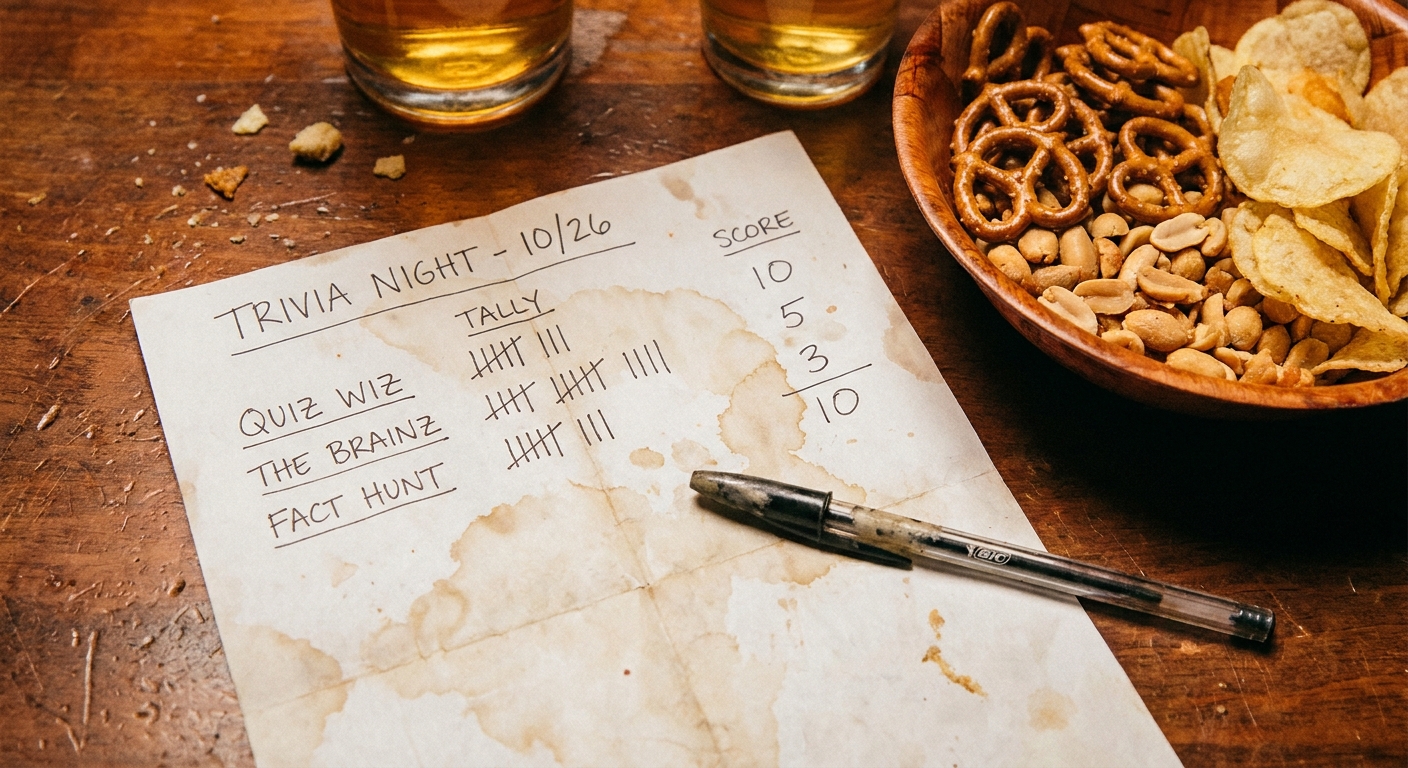
- Use a visible scoreboard. A simple sheet of paper taped to the wall works.
- Keep the tone playful. If a team misses “onomatopoeia,” congratulate them for at least spelling “onion” correctly. (I am kidding. Mostly.)
- End with a tiny prize. Bragging rights are traditional. Cookies are more effective.
Frequently asked questions
How many questions do I need?
For most groups, 30 to 50 questions is ideal. This article’s list is a full set of 50, already rounded into five tidy groups.
What ages does this work for?
These questions skew “family gathering friendly.” For younger kids, read aloud, allow teamwork, and consider giving multiple-choice options for the trickier terms.
Can I make this more like a puzzle night?
Absolutely. Add a short puzzle between rounds like a palindrome challenge or a “spot the typo” round inspired by famous typos.
Where can I find more topics for future nights?
The Trivia guide is a good jumping-off point, and if your crowd likes language oddities, untranslatable words always spark fun discussions.
One last tip
When you host, your main job is not “being right.” It is keeping the room light. If everyone leaves with a few new words, a few laughs, and at least one glorious collective groan, you did it perfectly.
And if you want to be extremely on-brand, name your event something like “A Night at the Vocabu-lair.” I will not stop you. I will, however, pretend not to know you in public.